Quotes by Maria Montessori about education
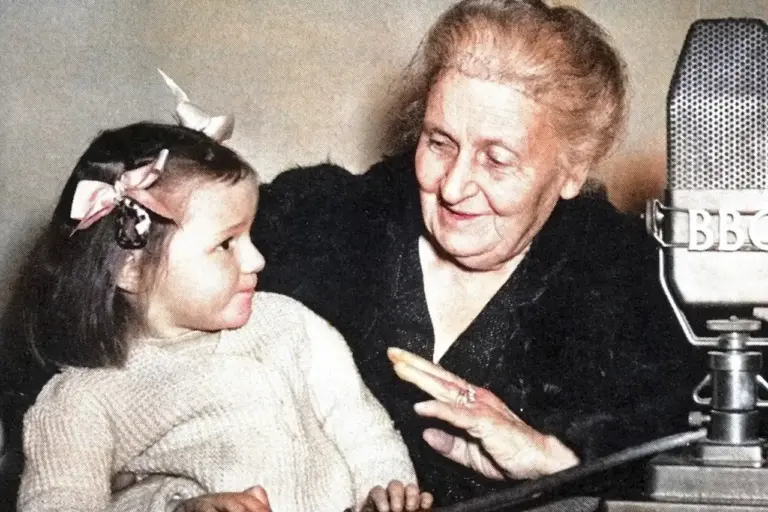
Below we prepared an inspiring collection of 40 quotes by Maria Montessori about education and her life-long philosophy:
The greatest sign of success for a teacher is to be able to say, ‘The children are now working as if I did not exist.’
The goal of early childhood education should be to activate the child’s own natural desire to learn.
Education is not something which the teacher does, but a natural process which develops spontaneously in the human being.
The first essential for the child’s development is concentration. The child who concentrates is immensely happy.
The child who has never learned to work by himself, who always needs help, will not be an independent adult.
To assist a child we must provide him with an environment which will enable him to develop freely.
The environment must be rich in motives which lend interest to activity and invite the child to conduct his own experiences.
Never help a child with a task at which he feels he can succeed.
The child is both a hope and a promise for mankind.
We must help the child to act for himself, will for himself, think for himself; this is the art of those who aspire to serve the spirit.


The child has a mind able to absorb knowledge. He has the power to teach himself.
The essence of independence is to be able to do something for one’s self.
Plainly, the environment must be a living one, directed by a higher intelligence, arranged by an adult who is prepared for his mission.
One test of the correctness of educational procedure is the happiness of the child.
Only through freedom and environmental experience is it practically possible for human development to occur.
The child is truly a miraculous being, and this should be felt deeply by the educator.
The child should live in an environment of beauty.
Establishing lasting peace is the work of education; all politics can do is keep us out of war.
Free the child’s potential, and you will transform him into the world.
The hand is the instrument of intelligence. The child needs to manipulate objects and to gain experience by touching and handling.
Education is a natural process carried out by the child and is not acquired by listening to words but by experiences in the environment.
It is necessary to give children the possibility of developing according to the laws of their nature, so that they can become strong, and having become strong, can do even more than we dared hope for them.
What the hand does, the mind remembers.
The child is capable of developing and giving us tangible proof of the possibility of a better humanity.
A child’s work is to create the person she will become.
The child has a different relation to his environment from ours. Adults admire their environment; they can remember it and think about it, but the child absorbs it.
The land is where our roots are. The children must be taught to feel and live in harmony with the Earth.
Imagination does not become great until human beings, given the courage and the strength, use it to create.
The child is an enigma… He has the highest potentialities, but we do not know what he will be.
The secret of good teaching is to regard the child’s intelligence as a fertile field in which seeds may be sown, to grow under the heat of flaming imagination.
There is no description, no image in any book that is capable of replacing the sight of real trees, and all the life to be found around them in a real forest.
We cannot create observers by saying ‘observe,’ but by giving them the power and the means for this observation and these means are procured through education of the senses.
Respect all the reasonable forms of activity in which the child engages and try to understand them.
The study of love and its utilization will lead us to the source from which it springs, The Child.
The education of even a small child, therefore, does not aim at preparing him for school, but for life.
The things he sees are not just remembered; they form a part of his soul.
There are many who hold, as I do, that the most important period of life is not the age of university studies, but the first one, the period from birth to the age of six.
We discovered that education is not something which the teacher does, but that it is a natural process which develops spontaneously in the human being.
The teacher’s task is not to talk, but to prepare and arrange a series of motives for cultural activity in a special environment made for the child.
The child becomes a person through work.
In conclusion, Montessori education tries to spark a child’s natural curiosity, to help them be independent, self-confident, and respectful.